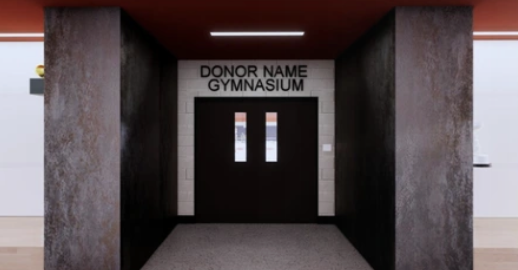
Two spaces within the school build-ing will be named for donors under a proposal submitted to the District 200 Board of Education on Feb. 12.
The donations will go toward the Oak Park and River Forest Imagine Foundation’s fundraising efforts for the estimated $102-million Project 2, the new athletic wing now under construction.
The proposals, announced at the Feb. 12 meeting, were set to be approved at the Feb. 26 board meeting at press time. Board members appeared favorable to the proposition.
“Just thank you to the donors,” board member Joshua Gertz said.
Karin Sullivan, OPRF’s executive director of communication and community relations, also expressed gratitude.
“We’re thrilled. Members of this community have a multitude of deserving organizations to which they might donate money,” Sullivan said in a statement. “We are incredibly grateful that they’ve chosen OPRF as the recipient of their generosity.”
Under the proposals, the Linda Tibensky family will donate $25,000 to name the classroom where Linda Tibensky taught Spanish, and Chatka Ruggiero will give $100,000 to name the Dance/Multipurpose Gym and the SRC Elevator. The naming rights are in effect for 10 years.
Both of the donors have strong connections to OPRF. Linda Tibensky taught at OPRF for 18 years, while her husband, John, served on the OPRF Booster Club for 12 years. Their son, Hank, is a graduate of OPRF. In addition, the family sponsors the Tibensky Family Scholarship Fund through the Oak Park River Forest Community Foundation that provides financial support for OPRF-sponsored travel enrichment programs.
Both of the donors have strong connections to OPRF. Linda Tibensky taught at OPRF for 18 years, while her husband, John, served on the OPRF Huskie Booster Club for 12 years. Their son, Hank, is a graduate of OPRF. In addition, the family sponsors the Tibensky Family Scholarship Fund through the Oak Park River Forest Community Foundation that provides financial support for OPRF-sponsored travel enrichment programs.
John Tibensky first heard about the possibility of having a space in OPRF named after his family after reading an article in the Wednesday Journal about the Armstrong family, which has donated money to have the Little Theatre named after them. Hearing about the opportunity motivated Tibensky, and his wife, Linda, to learn more about the opportunity.
“My wife was a high school Spanish teacher, and we thought this would be a terrific way of honoring her contribution to the school and all that she got from the students and all that they got from her,” Tibensky said.
Tibensky also emphasized the role of OPRF in the community.
“The high school in our opinion is the linchpin of what makes the community great,” Tibensky said. “It makes an important contribution to parents, the students, the whole community.”
Chatka Ruggiero is a graduate of OPRF and a community philanthropist. She currently serves as an advisor to the board for the Animal Care League after previously serving as board president.
Other named donations to support Project 2 include the new weight room, a new science lab, the new green room, a new yoga/meditation classroom and the little theater. Many spaces remain available for naming opportunities, ranging from the Student Resource Center (SRC) to the new aquatics facility. The cost of naming rights ranges from $25,000 to $2 million. Gifts do not have to come from a single donor.
OPRF may raise money through naming rights for the next major phase of construction, known as Project 3 or Act 3 because it would overhaul performing arts spaces. “There could be naming rights for some of that if Act 3 moves forward,” District 200 Board President Audrey Williams-Lee said.
Heidi Ruehle, the executive director of the Imagine Foundation, is hopeful that the Imagine Foundation will be able to add Project 3 spaces to the list.
“I do hope [so] because there are a lot of people who really want to honor their family, their multigenerational family or possibly loved one who passed,” Ruehle said. “To be able to have that ability in the performing arts area of this project would be significant.”
Currently, the Imagine Foundation is focused on raising their $12.5 million contribution for Project 2 costs, Ruehle said.
“We’ve raised close to $11.7 million, and we are committed to giving $12.5 million to the high school. Next week, we’ll be giving our fifth-million dollar gift because even though people have committed to the donations, a lot of these larger donations are in multi-year gift agreements or pledges,” Ruehle said. “We don’t have it all cash in hand right away so as soon as we bring in around a million dollars, we turn it right over to the high school.”
Project 2 is a part of the Imagine Plan, which is a five-phase plan for long-term developments for OPRF. Project 2 includes renovations of the physical education spaces, including a new pool, new multi-purpose gyms, as well as a renovated green room for the performing arts.
Williams-Lee believes the renovations are essential to ensure a good physical environment for students.
“Having a good physical environment, I believe, is very conducive to students being able to do better when they’re at school,” Williams-Lee said. “Whether it’s on the physical education side or the work from Project 1 that gave us the Student Resource Center, I think all of that makes a difference for our students being able to feel more comfortable and perhaps feel more engaged.”
OPRF was built between 1907 and 1967, which is a necessary reason for improvement, Sullivan said.
“Most of our facilities hadn’t been substantially improved since they were built and suffered from what we call the “three C’s”—inadequate condition, configuration, and capacity,” Sullivan said. “The Imagine plan is the roadmap for ensuring that our learning spaces meet the needs of both current and future students.”
The donations the Imagine Foundation has received through naming recognitions and other manners matter significantly, Ruehle said.
“The high school is such an important community asset. First of all, a lot of people move here because the schools are so good, but in particular the high school,” Ruehle said. “Not only does that help our real estate values but it just helps keep our businesses afloat and a thriving community.”