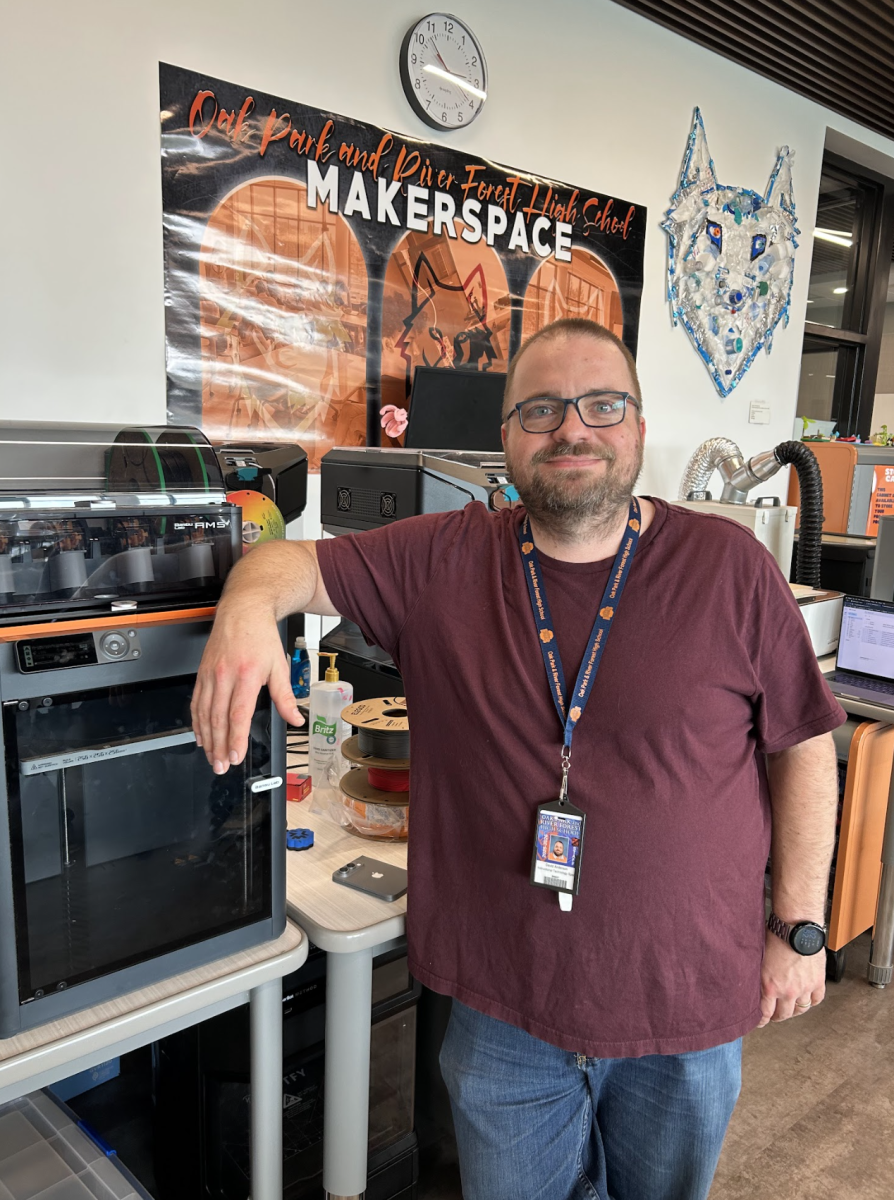
Amid the gentle but insistent whir of 3D printers, idle chatter of students and the sound of scissors against paper, David Anderson holds court in the Oak Park River Forest High School Makerspace.
This hub of creativity, located at the back of the Student Resource Center, is a place where students can follow their own interests in art, crafting, technology or sound recording. As the school’s instructional technology specialist, Anderson is a constant presence there.
“I spend most of my day here,” said Anderson, who seems not to mind. A self-professed computer nerd, his main area of expertise is the machines in the Makerspace, such as 3D printers, laser engravers and more.
“I do that as a hobby outside of school,” he said. “My basement kind of looks like a mini Makerspace. I have 3D printers down there. I’ve got lots of tools, and so I like tinkering and fixing things and building things. I’ve done that my whole life, even when I was a little kid.”
Now that he’s grown, he’s inspiring other kids, though they aren’t quite so little, to do the same. Anika Sherman, a senior, took a course on makerspace technology, something she constructed herself in lieu of a digital literacy class. Anderson taught the course, and Sherman worked as an intern in the Makerspace, learning how to work the machines. Sherman said Anderson is a helpful thought partner for students, particularly “when we’re trying to solve a problem and he’s like, ‘This is what would look better, or this would look nicer.’”
Anderson, a former engineer, certainly knows about problem solving, and Sherman says his passion for it is visible. They described a situation in which a printer could not print all the colors they wanted for their project, and that when they consulted Anderson, he threw himself into fixing it.
Students aren’t the only ones who admire his problem-solving skills. Emily Cepican, a fellow teacher who works in the space with Anderson, focusing more on helping staff, said, “When I see David with a kid, there’s a lot of patience and understanding, and he’s willing to explain to a kid in depth what this will take…He’s always willing to take the time.”
He took the time to explain to a student asking about a certain tool for 3D printing. The student only asked what it was and where he could get one, but Anderson also told him about the best and cheapest places to get them.
3D printers are complex machines that require expert oversight, even if they look as simple as pressing the right buttons, and on a smooth day, Anderson says, his job is indeed just that. But he is also the one to set up machines when they come, as well as to keep them running smoothly. “When I do my job well, it looks like that. You come in, you push the button and it works. When I don’t do my job well, you push the button and nothing happens. And I don’t know why and I can’t help you,” he said with a laugh.
He says the printer (paper, not 3D), is the machine that gives him the most grief. People often come in thinking they know how to use it, don’t, and mess things up, he says. But you wouldn’t know that when you watch him help students with printing, as he patiently talks them through what to do. But perhaps patience is the wrong word, as it implies discomfort.
“This would have been the place I wanted to hang out [in high school],” said Anderson. “…The types of people who would be my friends would be in here.”