Every few years, Oak Park does what Oak Park does best: polish the bronze plaques, update the museum and remind the world that Ernest Hemingway (a Nobel Prize winner, big game hunter and father of modern American prose) grew up right here in our beautiful tree-lined neighborhood. He attended Oak Park and River Forest High School and even wrote for Trapeze.
We say it with pride like a parent whose kid became famous. But we forget that the kid, the moment he could leave, took it, sprinted for the door and never really looked back.
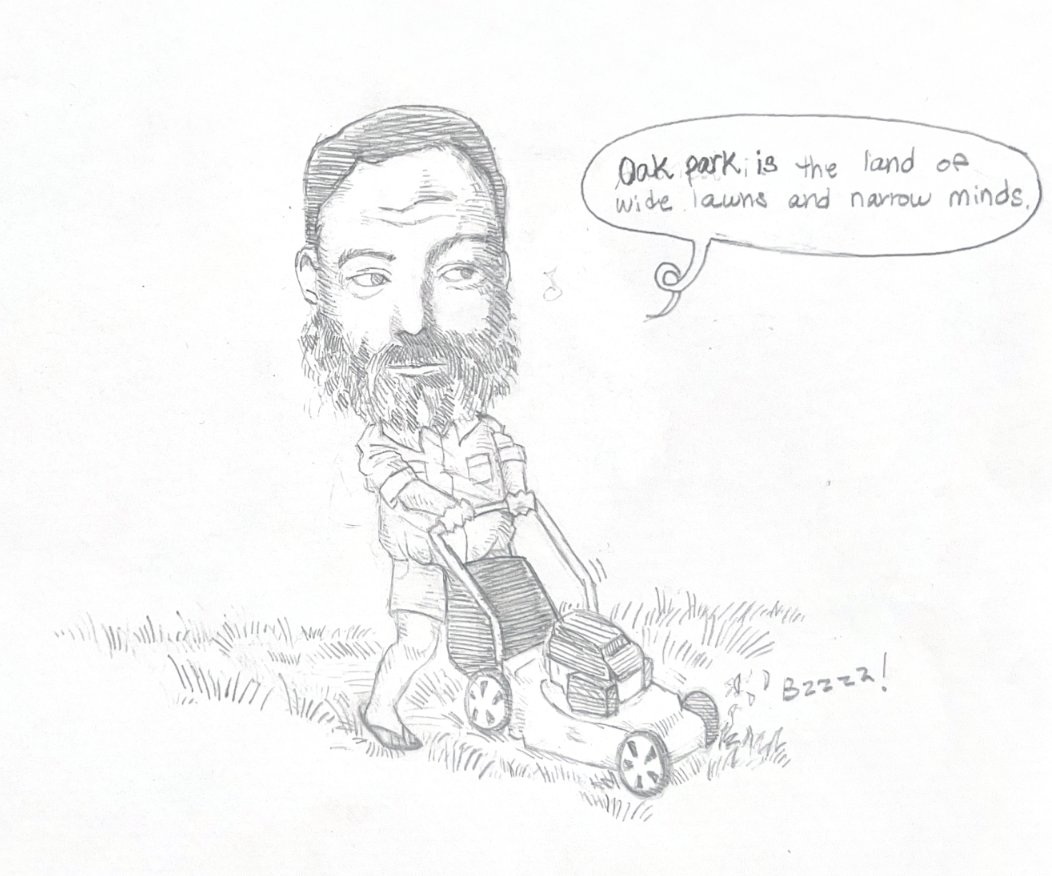
Hemingway reportedly called Oak Park a town of “broad lawns and narrow minds” (though that quote might be apocryphal, according to The New York Times). But it’s worth noting that, according to Chicago Magazine, “Hemingway left Oak Park when he was 18, to serve as an ambulance driver in World War I, and rarely came back home, either personally or in his fiction.” He seemed to shy away from his suburban Midwestern roots.
So here is the question Oak Park never asks: if Hemingway thought we were so boring, why do we put his name on everything?
That’s just what towns do. Stratford-upon-Avon does not spend much time worrying about whether Shakespeare would have wanted a gift shop or not. There is something to that logic.
Hemingway is definitely a tourist draw. There is the Ernest Hemingway Birthplace House at 339 N. Oak Park Ave., the Hemingway Museum at 200 N. Oak Park Ave., as well as the Hemingway Foundation of Oak Park, the Hemingway Business District and Hemingway’s Bistro.
We have built an identity, in part, around a man whose primary artistic statement about us was “I had to get out.”
To be fair to Hemingway (and we are apparently contractually obligated to be fair to Hemingway) the tension between a writer and their hometown is almost a genre too good. Of course, he had to leave. Of course, he mythologized leaving. That is what the best writers do, right? The “narrow mind” he escaped gave him something to push against, and the pushing produced great fiction, and so perhaps Oak Park deserves a small royalty.
But “he needed to reject us” is such a strange thing to celebrate. It is like a little restaurant proudly framing a one-star Yelp review or like breaking contact with your mother just for the “plot.”
What might actually be worth celebrating is the fact that today we are not the town Hemingway resented. We are more diverse, progressive and genuinely interesting than the “narrow minds” he grew up with. It is ironic that Hemingway’s Oak Park barely exists anymore. We have, in some sense, outgrown the version of ourselves he was running from. That’s the better story.
So I’m not saying that you shouldn’t read Hemingway’s books or visit the museum, because that would be ignoring the fact that he was one of the best authors in the modern era. But before you do so, just consider whether we should be celebrating someone who left Oak Park behind the first chance he got.