Before the skyscrapers, before the bungalows, before the postwar ranch houses and the Naperville McMansions, there was the two-flat. You’ve seen it a thousand times without really seeing it. Two stories. brick, a front
porch, a shared entry and two doorbells. Maybe a bay window and a greystone or brick facade. It was the building that absorbed Chicago’s immigrant waves, funded working-class mortgages, and quietly produced more
middle-class families than any policy the city ever wrote. In Chicago, they occupy more than 27% of the city’s housing stock. Through the late 19th and early 20th centuries, Chicago was growing faster than any other American city. Waves of migrants from all over the country and the world were flocking to Chicago in search of economic prosperity in the booming industrial city. This rapid population growth led to a major housing shortage, and the humble worker’s cottage, Chicago’s first signature home, simply couldn’t provide the density necessary to support America’s second city.
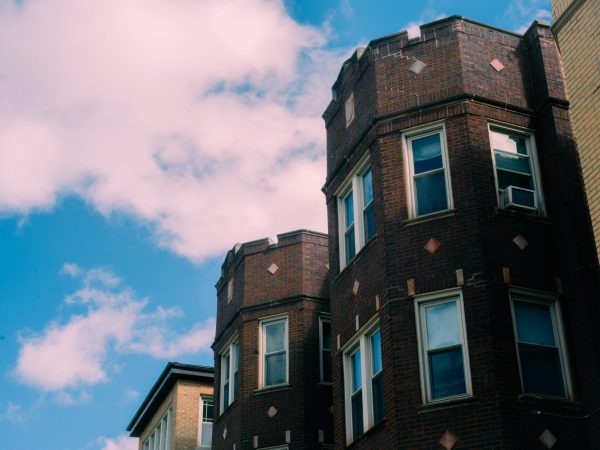
The answer came in brick and greystone. Two full wythe-layers of it, thick enough to stand for centuries. Long, narrow floor plans engineered for Chicago’s standard 25-by-125-foot lots. Gangways between buildings, mandated after the Great Fire, keep structures detached and ventilated. Each unit runs front to back, and has real square footage, often three bedrooms or more, stacked one on top of the other under a single roof.
It had the perfect amount of density to feed an endless tide of new Chicagoans, while maintaining neighborhood character. Importantly, owners could occupy one unit, rent the other and then let the tenant cover the
mortgage, building equity in their new setting.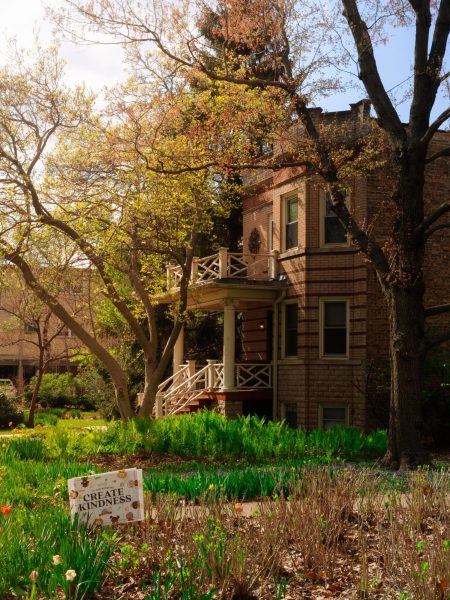
Builders couldn’t put them up fast enough, as over 76,000 were built in just the first few decades of the 20th century, according to the DePaul Institute for Housing Studies. Along with the two-flat came the three-flat, four-
flat, and even six-flat buildings, as demand for more density grew. These buildings generally stayed architecturally consistent, with the same blueprint seen everywhere from Little Village to Logan Square to Oak Park.
The people who built Chicago’s two-flats weren’t big developers; they were individual families, and overwhelmingly Eastern European immigrants. It was Polish families building around Milwaukee Avenue and Czech
immigrants pushing west along Cermak. A 1903 Chicago Tribune headline pronounced: “BOHEMIANS IN LEAD AS BUILDERS OF HOMES.”
It was, for thousands of families, the difference between surviving in America and building a life in it, with the two-flat serving as a direct pathway to the American dream.
At a time when the median home price in Chicagoland has surged past $350,000 and mortgage rates sit above 7%, it shouldn’t come as news to you that this, and frankly any pathway, to the American dream has all but closed. The financial logic and upward mobility that the two-flats fit perfectly is exactly what’s missing from a housing market that increasingly serves people who are already exceedingly wealthy.
Nationally, building two-flats is illegal in an overwhelming majority of zoning codes, including roughly 80% of Chicago, a city with some of the most progressive zoning in the country. In the suburbs, where new housing is being built, only 3% of land is zoned for two-flats. About 30% of Oak Park is zoned for two-flats, higher than most of Chicagoland, but still far short of what our economic moment requires.
“There is no part of Oak Park where a two-flat is inconsistent with the historical character of the Village,” said Village Trustee Brian Straw in a 2026 interview with Evanston Now. He’s right. The village didn’t become what
it is despite this building; it became what it is because of it. The two-flat was an economic model that worked for generations of working families who built this city. That kind of entry point has nearly vanished from the American housing market, and Oak Park has a chance to bring it back. The question isn’t whether the two-flat fits here; it’s whether we’re willing to let it.