One morning in October, an Oak Park attorney named Scott Sakiyama followed a van from the Broadview Immigration and Customs Enforcement (ICE) facility to Oak Park, where it happened to drive down the same block as his child’s elementary school. He honked his horn and blew a whistle to warn nearby parents.
Moments later, agents pulled him from his car, handcuffed him and detained him, he told Trapeze. Sakiyama was released soon after, but the scene left people in the neighborhood shaken. Sakiyama was charged with impeding a federal officer and cutting off an agent’s vehicle.
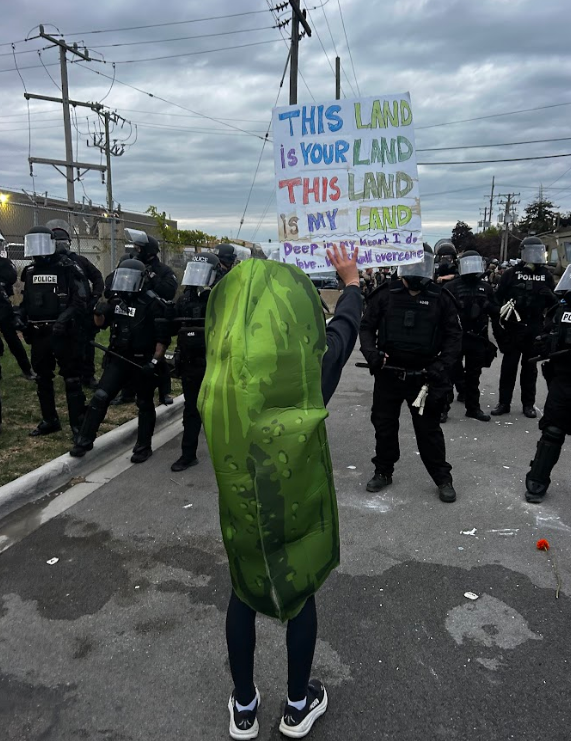
When Oak Park resident Autumn Reidy-Hamer protested outside the Broadview ICE facility, federal agents responded with “tear gas, pepper spray, shoving and a flash-bang grenade”. As a result, she filed a lawsuit along with a group of media organizations and citizens, including an Oak Park resident, claiming they violated their First Amendment rights.
Stories like these feel distant until they happen somewhere familiar. It’s unsettling to think about how quickly a normal day can turn into a moment where someone’s rights are questioned.
For students at Oak Park and River Forest High School, this raises an important question: What can we do when our rights feel uncertain or ignored?
The first step is to understand what protections students actually have. The American Civil Liberties Union reminds students that they do not give up their constitutional rights when they enter school. The Supreme Court made that clear in Tinker v. Des Moines (1969), when students were punished for wearing black armbands to protest the Vietnam War. The Court ruled in their favor, saying students keep their right to free expression as long as it does not cause major disruption to school activities.
That might sound distant from high school life now, but it applies more often than most people think. Maybe it’s a student newspaper article that makes administrators nervous, or a protest about a school decision. Maybe it’s a teacher asking a student to take off a shirt with a political message. Understanding your rights does not mean picking fights; it means knowing when something crosses a line.
The next step is to pay attention to what happens around you. Rights are not always taken away through big, obvious acts of injustice. Sometimes it is small things that build up: a student punished unfairly, a policy that feels targeted or a rule enforced only on certain people. It is easy to dismiss these moments, but noticing them is part of protecting your rights.
When Sakiyama blew his whistle, he was not trying to make a political statement. He saw something wrong and reacted. Students can do that too by speaking up, asking questions and supporting classmates who might feel powerless. Document what you see if it is safe to do so, and bring issues to trusted teachers or school leaders. Small actions like that help make schools fairer and safer for everyone.
It also helps to know where to go for support. Public schools are bound by federal civil rights laws. Title VI bans discrimination based on race or national origin, Title IX covers gender, and other laws protect students with disabilities or religious differences. There are also local resources, like community legal aid groups or the American Civil Liberties Union (ACLU) of Illinois, that exist to help when something feels off. Students across the country have learned to navigate these systems through programs like the Marshall-Brennan Constitutional Literacy Project, which teaches young people how the law applies to their own classrooms.
Learning about your rights can seem abstract, but it becomes real the moment those rights are challenged. At OPRF, protecting civil liberties means more than knowing laws. It means looking out for each other and creating a community where fairness actually means something.
When someone like Sakiyama is detained outside a school, it reminds us that our rights cannot be taken for granted and shows the power of awareness and response. Students at OPRF do not have to wait for someone else to defend their freedoms. They can start by paying attention, speaking honestly and caring about the kind of school they want to be part of.