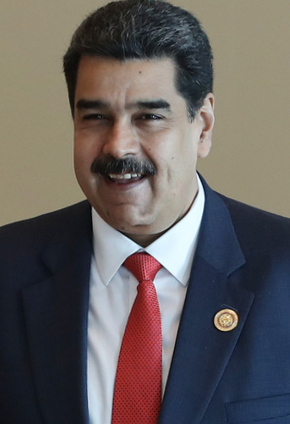
In the early morning hours of Jan. 3, U.S. Army Special Forces captured Venezuelan President Nicolás Maduro and First Lady Cilia Flores in “Operation Absolute Resolve.” The pair was taken to the U.S. on narco-terrorism and weapons charges.
Since his election in 2013, Maduro has been plagued by protests and controversy. His regime faced allegations of election fraud, blocked recall efforts, and was accused of widespread human rights abuses. About 7 million Venezuelans have fled the country, according to Human Rights Watch.
Daniel Rodriguez-Bovio, an Oak Park and River Forest High School student whose parents immigrated from Venezuela in the early 2000s, said the government operated “like a dictatorship,” using “tear gas and violence” to suppress protesters.
Rodriguez-Bovio said that his grandmother, who lived in Venezuela under the Maduro regime, often lacked internet access and experienced power outages that shut down water pumps, cutting off the water supply due to government mismanagement. Rodriguez-Bovio described Maduro’s capture as “a great moment,” adding that he “never thought it would happen in [his] lifetime.”
Maduro’s removal was a triumph against authoritarianism and a victory for Venezuela. Still, U.S. action since Maduro’s deposition suggests that a solution in Venezuela remains distant, and it’s unclear whether the U.S. intends to create meaningful change. U.S. officials claimed their intervention would democratize the nation and curb drug trafficking, but their actions show that the primary goal is to establish influence and exploit Venezuelan oil.
So far, Maduro’s removal has done little to bring about democracy, as key figures of his regime remain. U.S. officials have backed Maduro’s vice president, Delcy Rodríguez, despite popular support for María Corina Machado, a figure who has ardently supported democracy. Donald Trump said that Machado “doesn’t have the support or respect within the country.”
Further, Trump has often painted Venezuela as a hub for fentanyl trafficking, claiming that boats targeted by U.S. forces were “stacked up with bags of white powder, that’s mostly fentanyl.” However, a New York Times analysis showed, “There is no proof that it [fentanyl] is manufactured or trafficked from Venezuela or anywhere else in South America.”
Actually, the State Department and DEA identified Mexico as “the only significant source of illicit fentanyl.” This discrepancy shows that curbing fentanyl trafficking was never a viable outcome of the intervention, indicating that it served more as a political justification than an objective.
Instead, U.S. oil interests are the key motivator. Trump has openly claimed that the U.S. will completely control Venezuelan oil. The U.S. seeks stability primarily to protect its economic interests, rather than to genuinely support democratic reform in Venezuela or effectively combat drug trafficking.
At the same time, this operation sets a dangerous precedent for future international intervention and risks further geopolitical conflict. Under international law, the operation was unlawful. According to Mary Ellen O’Connell, Professor of Law and International Peace Studies at the University of Notre Dame, any use of military force across international borders is restricted by the United Nations Charter Article 2(4).
This includes the attacks in Caracas on Jan. 3, and the missile attacks on small boats allegedly carrying drugs on the Caribbean territory of Venezuela in the months prior. The United Nations permits force only with Security Council approval or in response to an armed attack. Neither occurred.
Trump repeatedly claims that the U.S. acted because of the threat of drugs coming into the U.S. from Venezuela. However, in the United Nations General Assembly, drug trafficking has never been recognized as an armed attack that would justify military force.
Further, U.S. intervention sets a troubling precedent for international intervention. Primarily, unopposed U.S. intervention in Venezuela revives the prevailing assumption that the U.S. retains the authority to influence all affairs within the Western Hemisphere.
This is problematic; it clashes with principles of self-determination and international law. Also, this belief is rooted in racist ideologies that justify U.S. intervention through the belief that Latin American nations aren’t able to effectively manage their own affairs.
In a broader context, if powerful nations feel that they reserve the right to remove supposedly illegitimate leaders of smaller nations, a nation’s sovereignty becomes controlled by a set of conditions set by the more powerful nations. As these justifications become normalized, both the legitimacy of the law and opposition to its violation erode.
Maduro’s removal may have closed one chapter of oppression in Venezuelan history, but more has to be done to resolve the crisis facing the country. It seems that the U.S. may have replaced one form of domination with another controlled by strategic interest. Without meaningful democratic reform, Venezuela’s future stays out of the hands of its people, and the nation remains without a clear path forward.