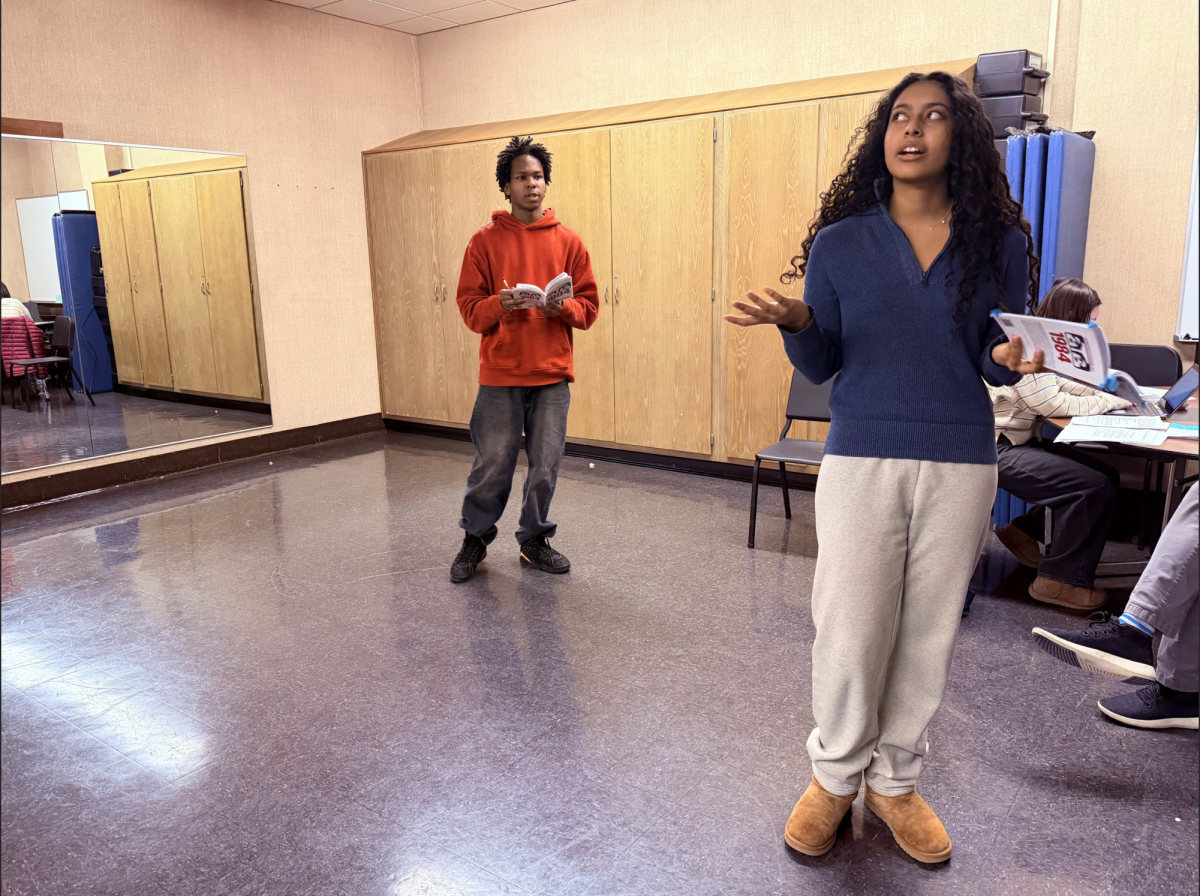
Big Brother is always watching, and soon, he’ll be watching the stage at Oak Park and River Forest High School. Adapted from George Orwell’s dystopian novel by Robert Owens, Wilton E. Hall Jr. and William A. Miles Jr. , the play “1984” follows Winston Smith, a man living under a totalitarian government where free thought is forbidden, truth is constantly rewritten and surveillance is the way of life. Through stark imagery and unsettling themes, the play explores what happens when individuality is crushed by power, giving audiences space to confront how much control is too much. “The show isn’t telling the audience what to think,” said Ajani Dosunnmu, who plays Winston.
The play will take place in The Little Theater Feb. 26 and 28 at 7 p.m. and Feb. 28 at 3 p.m. Tickets are available through the OPRF website.
Director James Bell, an OPRF English teacher, emphasized that his goal with “1984” is not to spell out a message for the audience, but to let them form their own interpretations. “I wanted to present the story,” Bell explained, rather than push a specific viewpoint. He noted that the play’s themes are not meant to be tied to a single time period. Bell aims to share with audiences a production they can sit with and think about later, giving the story’s meaning space to unfold on a personal level after they leave the theater.
Actors involved in the production described the challenge of portraying characters who live under constant psychological pressure. Sophomore Vivian Porrez, who plays the role of Julia, said that rebellion in “1984” often appears in subtle ways, explaining that, “everything she does is rebellion,” even small actions that might seem insignificant.
Junior Teddy Nielsen, who has the role of O’Brien, emphasized that much of the storytelling happens without dialogue, noting that emotion is communicated through “ your face, your tempo…” That proves to be a challenge as well, considering Big Brother is always watching.
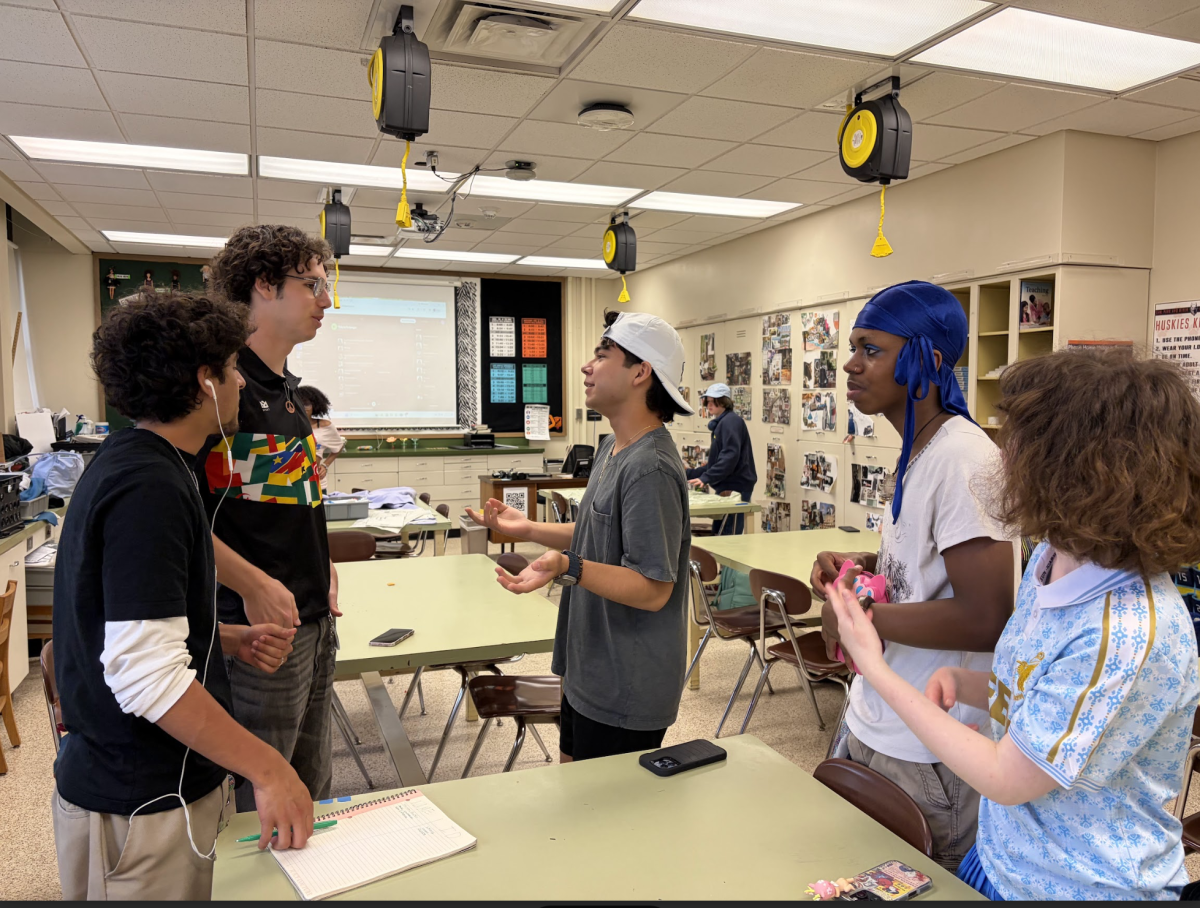
Several cast members also spoke about the difficulty of fully stepping into characters whose thoughts aren’t really their own. Despite the heaviness of the material, actors and crew described the rehearsal process as collaborative and rewarding, with many expressing excitement about bringing such a complex and unsettling story to the stage.
“It’s an interesting challenge to be able to portray characters whose ideas and opinions are so different from ours,” said sophomore Anna Kunkle, who plays Parsons, a supporter of the authoritarian regime. “You have to put aside your personal beliefs and preferences and understand the character’s importance in the story so that you can convey their feelings.”
As the cast continues to navigate the emotional and psychological weight of 1984, the rehearsal room has become a space for exploration, trust and restraint. By focusing on small choices and unspoken emotion, the actors create a depth to a story where silence can be as powerful as speech.
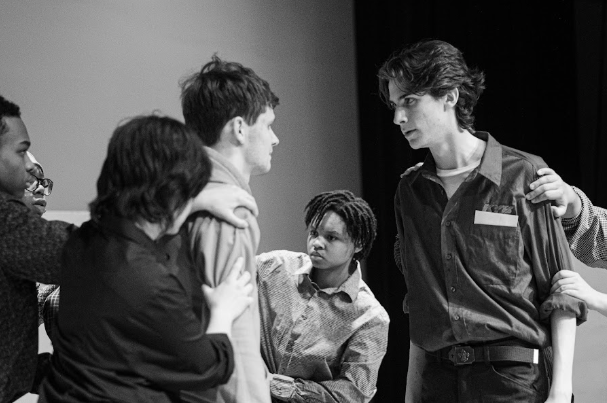
One moment that stood out in rehearsal was the cast’s repeated focus on controlled movement and silence. Actors were asked to redo scenes, not because of missed lines but because a gesture was too large or an expression lingered too long. In one scene, performers practiced standing completely still while maintaining eye contact, reinforcing the idea that even hesitation or discomfort can communicate rebellion or fear. These deliberate choices reflected the production’s emphasis on restraint and subtlety, mirroring constant surveillance and psychological pressure seen in 1984.
Rather than delivering a single message, OPRF’s “1984” aims to give audiences a carefully crafted experience shaped by collaboration and intention, and designed to linger well beyond the final scene.