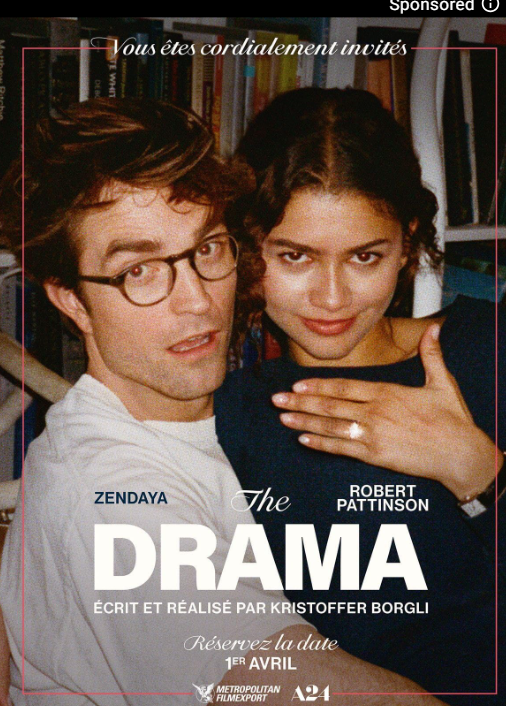
A24’s highly anticipated film “The Drama”came out April 3 and has already accumulated more than $65 million worldwide. Aside from the fact that it stars Zendaya and Robert Pattinson as love interests, its main attraction to viewers came from its iconic and intriguing trailer.
In the trailer, Emma (played by Zendaya) is playing a game with her fiance, Charlie (played by Pattinson), where they go around a table with their group of friends, saying the worst thing they’ve ever done. While Charlie and his friends get a laugh from the group after sharing, Emma gets an entirely different response. Despite the trailer not actually revealing what she said, the message is clear: there’s no going back.
The rest of the movie seemed driven by this horrible thing Emma did, as the dramatic shift in Emma and Charlie’s relationship is undeniable. This trailer captivated audiences, all wondering the same thing: What could she have done? Countless theories proliferated online: she was living a fake life, she killed her ex boyfriend, etc. But none of them predicted what she actually did.
I was one of these theorists that were extremely eager to see what Emma did, and when I finally watched the movie I was indeed shocked, but at the same time disappointed. The big reveal, in case you don’t know, was that when Emma was a teenager, she planned a mass school shooting. The movie showed clips of when she was a teenager: depressed, insecure, and drawn to violence. She had stolen guns, made videos online preparing for the shooting, yet never carried it out.
Seeing the flashbacks and confession, I assumed the filmmakers would take the extremely sensitive topic of adolescent gun violence and school-shootings and make the movie into a statement…but I was wrong there too.
As the movie progressed, her alarming confession became simply a hurdle that her fiance couldn’t get over. He was disturbed, as you would assume, but the framing of the film almost made it seem comedic. He was getting less disturbed by his fiance, less concerned, and more so frightened, frightened that this whole time Emma wasn’t who she said she was, that she was a gun-obsessed, violent psycho plotting on the next person who looks at her funny.
Charlie was haunted by the image of guns and violence, such as when a gun magazine was unknowingly put on his desk, and when he threw away a mug at their shared home that had a gun image on it. After each one of these gimmicks, my theater laughed. I was laughing too, given Charlie’s panicked paranoia, but then I began to think deeper about how the film could have been manipulating a serious topic for the sake of entertainment.
As the movie went on, the plot seemed to become less driven by the topic of gun-violence and the mental health crisis, and more driven by the relationship itself. They used the sensitivity of the topic to provide leverage for the overall questions the film raises: Can people really change? What can people excuse in the name of love?
The movie ended with Emma and Charlie, after their nightmare wedding (which they both walked out on), accepting each other and choosing to stay together despite their issues. But seeing youth violence and mass-shootings as simply a relationship issue is undermining the countless people who have been affected by youth gun violence. Exploring topics like gun violence, especially in the context of a child’s mind, needs careful evaluation. Using it as a gimmick, a surprising twist or a plot device, is making gun violence seem less than what it actually is.
Many Americans, who are constantly exposed to news about gun-violence, have become almost desensitized by it. Violence is no longer some shocking thing to most Americans, it’s simply a hard reality. But we can hold truth in this while also spreading awareness that it should not be normalized. Gun violence happens, but it shouldn’t. When given the privilege to cultivate a multimillion-dollar film with actors that will bring people into theaters, writers and directors should strive to make something that will not only tell a story, but make an impact.
The creators of “The Drama” ultimately got what they wanted. They got the actors, they got the money, they found the most uncomfortable, heart breaking topic to get their shock factor, yet made absolutely no impact.
Another way I felt this movie manipulated youth gun violence for the sake of entertainment was through the marketing. Before the film was released, fans were not only intrigued by the actors and trailer, but how they presented the movie. Zendaya wore wedding-related attire to her premiers and even surprised couples at their wedding ceremony.
The movie’s twist was obviously a secret, so they couldn’t have made their press tour focus on gun violence, but it is a topic that definitely needed some coverage. Making the marketing of the movie solely wedding and romance related made the twist even more surprising, but also even more offensive.
In a film addressing such a serious and sensitive subject, you would expect there to be some sort of credits message on gun violence or maybe even posts by the actors about school-shootings…yet there was none. Both Zendaya and Robert Pattinson have not advocated at all in spreading information on gun-violence to their viewers. Instead, they’ve done relationship advice interviews, cautioning fans that they need to know everything about their partner before they decide to tie the knot.
Overall, I felt “The Drama” did not handle its “twist” as well as it should have. Thinking about gun violence, especially youth gun violence, as a way to elevate a plot or gain that surprise factor is extremely flawed. If making a movie with this topic in it, I feel writers and directors need to handle it with major sensitivity and care. They need to convey to audiences how truly horrible and unfortunately common gun violence is, not make it into an eery, comedic plotpoint to shock viewers.