
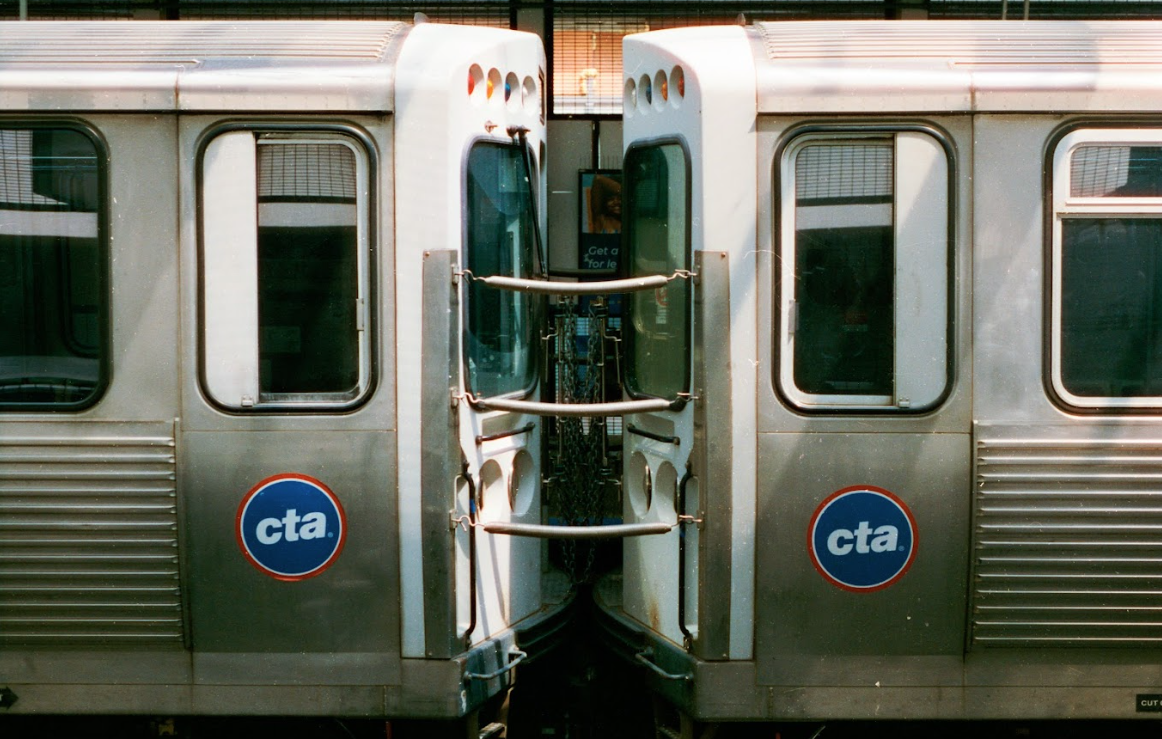
It’s early, it’s cold, and you’ve been standing on a Green Line platform for 15 minutes, watching the countdown for the next Ashland/63rd-bound train. Two minutes. One minute. Due. No train.
This is an experience that all Oak Parkers know all too well. For many, it’s a daily calculation: wait for a train that may or may not come, or get in the car. Those who can afford to drive increasingly choose the latter, and that choice matters. Because CTA funding is tied to ridership, every rider lost equals lost revenue, more service cuts, and more people pushed off trains and onto highways.
What was once shared public infrastructure turns into a last resort, treated less like a communal service for all and more like a subsidy for those with no other option. Recent violent incidents have shaken rider confidence, even as overall CTA crime fell 6% in 2o25.
Crumbling stations and unpredictable schedules riddled with ghost trains only accelerate the slide. And when wealthier riders leave, they take their political leverage with them. The result is a death spiral. Shrinking ridership cuts budgets, degraded service pushes riders away, and the cycle repeats.
Problems on the CTA have drawn criticism from the Trump Administration, which has threatened to cut federal funding if safety doesn’t improve as part of their larger racialized and fearmongered culture war against urban life. In December, the Federal Transit Administration (FTA) rejected the CTA’s revised safety plan and threatened to withhold $50 million in federal funding if its concerns weren’t addressed within 90 days.
As the deadline approaches, riders are already seeing the federal pressure play out. The CTA has launched the Transit Rider Interaction Program, deploying more visible Chicago police patrols at stations and on trains in an effort to respond to the federal government’s safety concerns.
But transit needs more than tougher law enforcement. It needs the long term stability that the CTA desperately lacks.
Threatening to withhold funds from a system already struggling with low ridership and shrinking budgets would simply accelerate the very death spiral that pushes riders away in the first place. Cutting federal funds now wouldn’t just squeeze the CTA’s budget on paper; it would make trains less reliable, schedules more erratic and riders feel like they’re being asked to choose between inconvenience and abandonment. That’s not smart policy; that’s letting the public good rot because it’s easier to blame than to fix.
In recent months, the state has stepped in to attempt to put a band-aid on this crisis, passing the NITA (Northern Illinois Transit Authority) Act on Oct. 31, 2025. The act provides approximately $1.5 billion in additional annual transit funding. The act will take effect on June 1, 2026.
NITA will replace the RTA (Regional Transit Authority) which oversees the CTA, Metra and Pace, but with expanded authority over fares, service, and planning compared to its predecessor.
NITA will be governed by a 21-member board appointed by Chicago, Cook County, the governor, and surrounding counties, and will have expanded authority to unify fares and coordinate service across CTA, Metra, and Pace, a change that could significantly improve transfers in Oak Park, one of the few communities served by all three. Its roughly $1.5 billion in annual funding will come primarily from reallocating the state gas sales tax, alongside a modest regional sales tax increase and interest from existing transportation funds.
NITA emerged as a last-minute solution after years of post pandemic transit funding battles. The CTA was about to fall off a “fiscal cliff” where they were projected to cut 40% of their service starting in 2026. This would have meant massive rail and bus cuts, with remaining service reduced to infrequent schedules.
With the NITA Act, the momentum is now pushing in a different direction. The new money pumping into Chicagoland transit won’t only avoid the CTA’s “doomsday scenario” but will also work towards some new improvements for the system. Planned improvements include 24-hour Orange Line service and a sharp increase in station deep cleans.
Oak Park likes to see itself as connected, progressive, and community-oriented.
Transit is where those values are actually tested. Trains and buses are some of the only places left where we aren’t separated by job titles, zip codes, or bank balances, where people from the full range of society are briefly forced into the same space. That closeness can be uncomfortable, but it’s essential. A healthy transit system does what cars never can; it puts Chicagoans in the same room. A society that can’t move together can’t function together. If the NITA Act is going to mean anything beyond keeping the lights on, it has to restore transit as a shared space, not a last resort for some, but a system that works because all of us use it.









Shannon • Jan 28, 2026 at 10:09 am
Great information!